 Studiely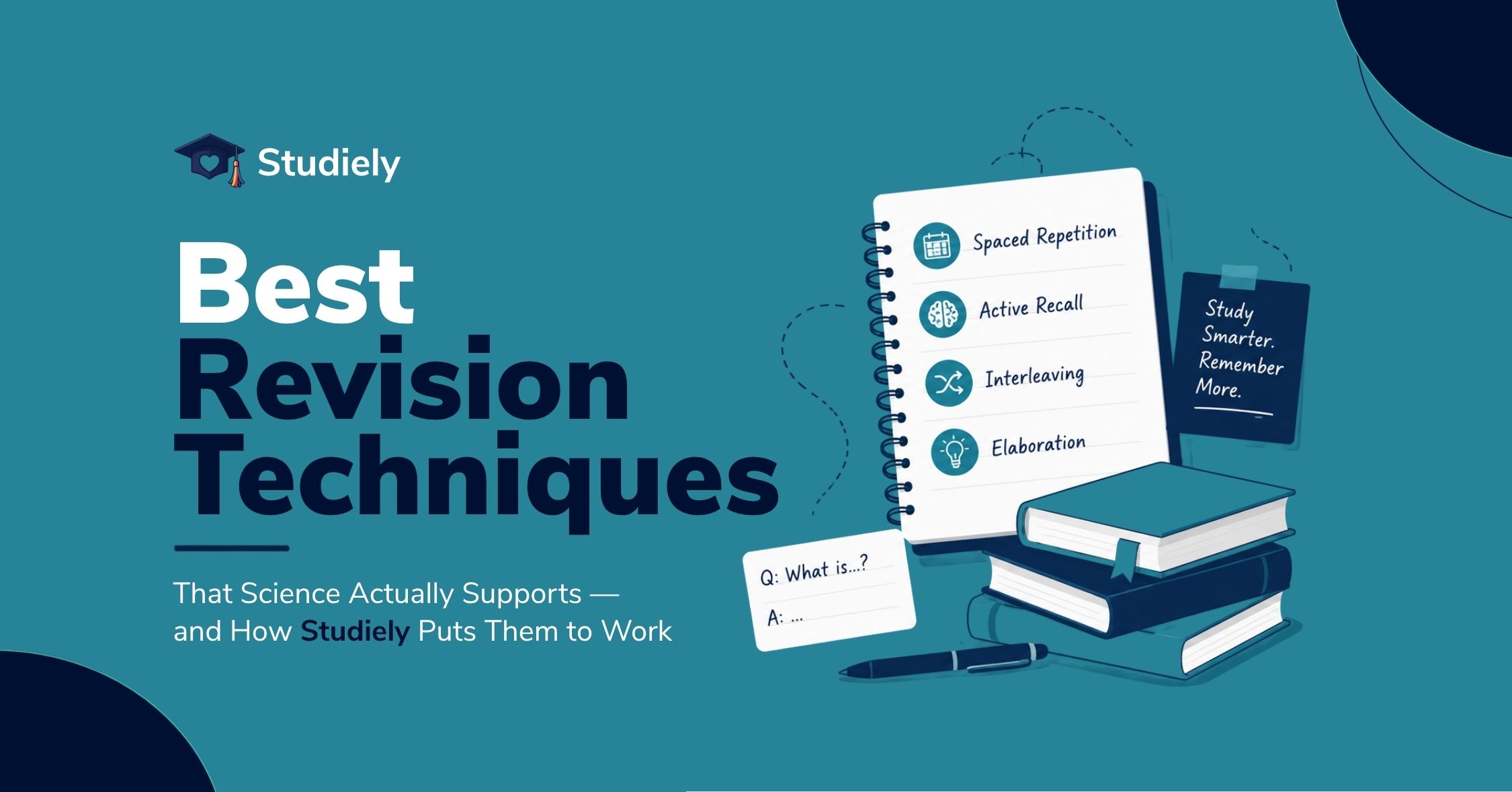
EdTech
The best revision techniques are not the ones that feel most productive — they are the ones backed by decades of research in cognitive science. And there is a significant gap between the two. Most students revise using methods that produce familiarity: re-reading, highlighting, watching lecture recordings. These feel useful. The research tells a different story.
In a landmark 2013 analysis published in Psychological Science in the Public Interest, researchers evaluated ten common study strategies used by students. The most popular methods — highlighting, re-reading, and summarization — received the lowest effectiveness ratings. The methods students use least — practice testing and distributed practice — received the highest. The revision techniques most students rely on are, by scientific measure, among the least effective available.
This blog covers exactly which revision methods the evidence supports, why they work, how to implement them without overhauling your entire study routine, and how Studiely automates the most powerful of them so that effective revision becomes your effortless default.
Why Most Students Revise Ineffectively — and Don't Know It
The core problem with passive revision methods is that they create what psychologists call fluency illusions — the feeling of knowing material that you cannot actually retrieve under exam conditions. When you re-read a chapter, the text feels familiar. Your brain interprets that familiarity as knowledge. It isn't. Familiarity is recognition — a much weaker cognitive process than retrieval, which is what exams actually demand.
This explains a pattern almost every student has experienced: reading your notes the night before and feeling confident, only to find the exam questions much harder than expected. The knowledge was never deeply encoded. It was only ever superficially familiar — and that familiarity evaporated the moment unfamiliar question framing removed the recognition cues.
The Best Revision Techniques Ranked by Evidence
1. Practice Testing (Active Recall)
The most evidence-backed revision method available to students. Testing yourself — through flashcards, past papers, practice quizzes, or self-generated questions — forces your brain to retrieve information rather than recognize it. Each retrieval attempt, whether successful or not, strengthens the memory trace. Research consistently shows that a single study session followed by multiple practice tests produces 50–80% better retention at one week than additional study sessions without testing.
2. Spaced Practice (Distributed Revision)
Distributing revision across multiple sessions over time produces dramatically better long-term retention than concentrating the same total hours into a single cramming block. The forgetting curve — first described by Hermann Ebbinghaus in the 1880s — shows that we forget approximately 70% of new information within 24 hours without reinforcement. Spaced review interrupts this curve by re-engaging the memory just before it would be lost, rebuilding it at a progressively higher baseline each time.
3. Interleaving
Rather than studying all of one topic before moving to the next (blocked practice), interleaving mixes different topics or problem types within a single session. It feels harder — because it is harder — but that difficulty is productive. Interleaving forces the brain to continually re-identify which concept applies to which type of problem, building the flexible understanding that exams demand and blocked practice rarely develops.
4. Elaborative Interrogation
Rather than accepting a fact at face value, elaborative interrogation asks 'why is this true?' and generates an answer before checking. This connects new information to existing knowledge, creating richer, more networked memory traces that are significantly easier to retrieve. It works particularly well for content-heavy subjects — biology, history, economics — where understanding the reasoning behind facts matters as much as the facts themselves.
5. The Feynman Technique
Named after physicist Richard Feynman, this technique involves explaining a concept in simple, plain language as if teaching it to someone with no prior knowledge. Where your explanation becomes unclear or you have to refer back to your notes, you've identified a genuine gap in your understanding. The process of simplifying forces depth of comprehension that passive reading never achieves.
The Exam Revision Techniques You Should Stop Using
Just as important as knowing which study strategies work is knowing which ones to deprioritize — because time spent on ineffective revision is time not spent on effective revision.
Re-reading notes or textbooks. Produces fluency illusions without building retrieval strength. If you're going to re-read, immediately follow it with active recall practice on the same material.
Highlighting and underlining. Makes important information visually salient — but does nothing to encode it. High-yield only when used as a precursor to note-making or self-testing.
Passive summary writing. More useful than re-reading, but still largely a production task rather than a retrieval one. Better replaced with Cornell Note format, where you hide your notes and test yourself from the questions you've written in the margin.
Cramming the night before. Generates temporary familiarity that decays within 24–48 hours of the exam. Useful only as a final refresher on material already deeply learned — disastrous as a primary study strategy.
Eliminating these methods entirely isn't realistic. But reducing them in favor of even a shorter session of active recall practice produces a net gain in outcomes, not a loss.
How Studiely Implements the Best Revision Methods Automatically
The reason most students don't consistently use the best revision techniques isn't ignorance — it's friction. Setting up a spaced repetition schedule manually is time-consuming. Creating quality practice test questions from your notes takes hours. Tracking which topics need more work requires discipline that competes with everything else in a student's life.
Studiely removes every piece of that friction. Paste your lecture notes and within seconds you have an active recall practice deck built from your specific course material — no manual question writing, no scheduling decisions, no tracking spreadsheets. As you study, spaced repetition runs automatically in the background, returning each card at the optimal interval. Adaptive difficulty ensures every session is weighted toward the material you're still uncertain about.
The result: you study using the best available revision methods every time you open Studiely, without needing to design or maintain the system that makes them work.
Frequently Asked Questions
What are the best revision techniques for exams?
The revision techniques with the strongest evidence behind them are practice testing (active recall), spaced practice, interleaving, elaborative interrogation, and the Feynman technique. Of these, practice testing and spaced practice consistently produce the largest improvements in long-term retention and are rated highest in educational psychology research. Studiely implements both automatically from your own course material.
How many hours of revision is enough before an exam?
There is no single right answer — it depends on the difficulty of the material, your starting knowledge level, and the nature of the exam. More important than total hours is the quality of revision. Research consistently shows that shorter sessions using active recall and spaced repetition produce better outcomes than longer sessions of passive re-reading. Starting revision at least two to three weeks before an exam and studying in shorter distributed sessions is far more effective than intensive cramming in the final days.
What is the most effective revision method?
Based on the available research, practice testing — also called active recall or retrieval practice — is the single most effective revision method. It consistently outperforms all other study strategies in controlled studies measuring long-term retention. The combination of active recall with spaced repetition (reviewing at strategically increasing intervals) is even more powerful than either practice alone.
Does highlighting help with revision?
Highlighting on its own has a very low effectiveness rating in educational research. It makes important information visually salient but does nothing to encode that information into long-term memory. Highlighting becomes more useful when it is used as a first step — identifying key content — immediately followed by active recall practice on the highlighted material. As a standalone revision strategy, it should be deprioritized in favor of more active methods.
How does Studiely help with exam revision?
Studiely automates the three revision techniques with the strongest evidence base: active recall (by generating practice questions from your notes), spaced repetition (by scheduling card reviews at optimal intervals automatically), and adaptive difficulty (by prioritizing your weakest areas in every session). It removes the friction that prevents most students from implementing these techniques consistently on their own, making effective revision the path of least resistance.