 Studiely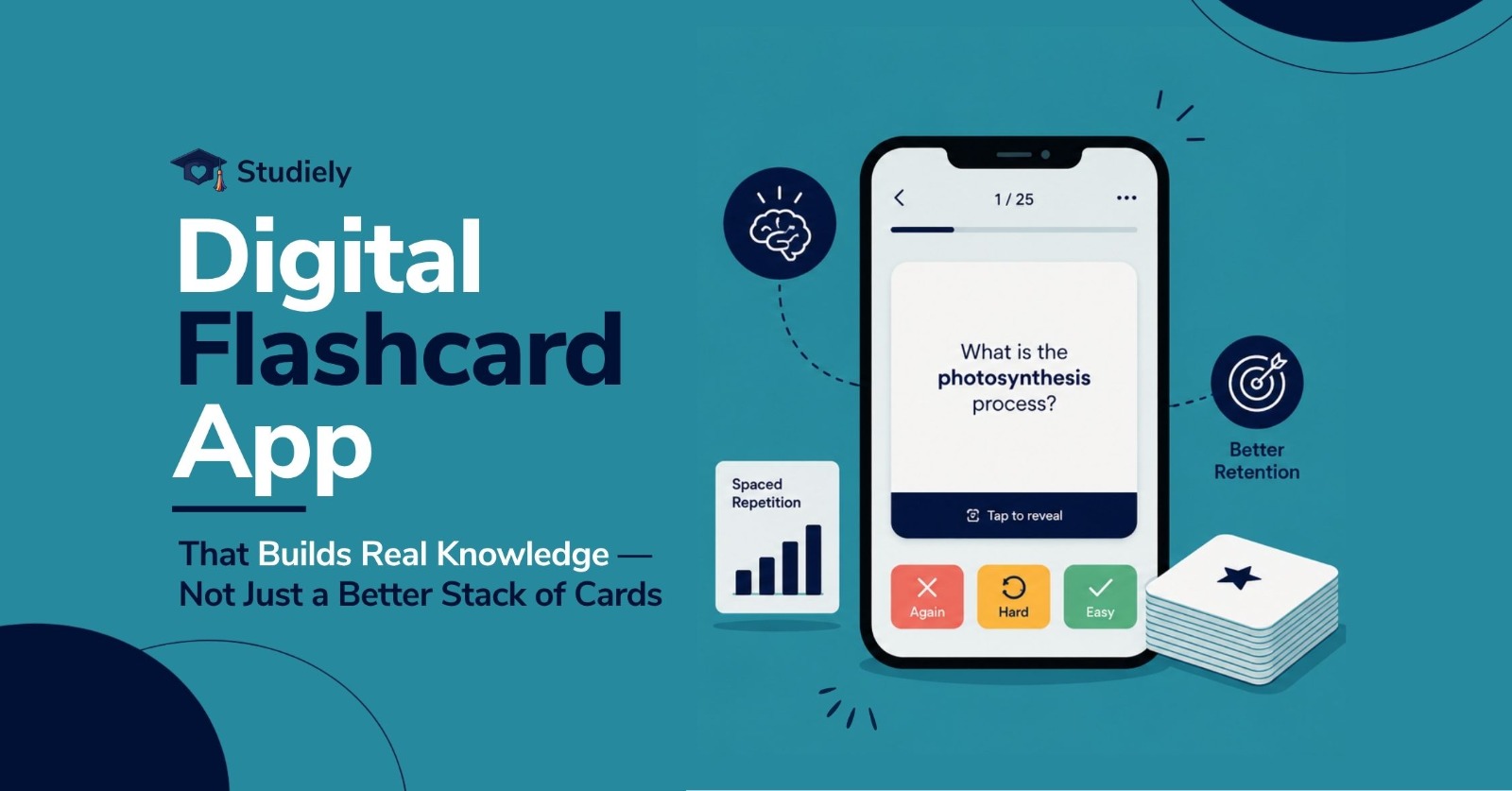
AI Tools in Study
The digital flashcard app market is one of the most crowded categories in educational technology — and most of the products in it share the same fundamental limitation as the paper flashcards they replaced: they present information, but they don't learn from how you interact with it. A genuine digital flashcard app in 2025 does far more than display a question on one side and an answer on the other. It tracks your performance on every card across every session, implements spaced repetition to schedule reviews at the optimal moment for memory consolidation, and weights future sessions toward the concepts you're still struggling with. Studiely does all of this — automatically, from your own course material.
This blog explains why flashcards work when they're used correctly, what separates a basic online flashcard app from a genuinely intelligent study system, and why Studiely is the revision cards tool that changes academic outcomes rather than just digitizing the process.
Why Flashcards Work: The Science Behind Active Recall
Flashcards are not effective because they're a convenient way to organize information. They're effective because the process of using them — looking at a question, attempting to retrieve the answer from memory before flipping the card — engages a cognitive mechanism called the testing effect, also known as retrieval practice.
The testing effect is one of the most robust findings in cognitive psychology: the act of retrieving information from memory strengthens the memory more than additional study does. When you read a flashcard prompt and try to produce the answer before checking, your brain is doing something fundamentally different from reading through your notes. It's constructing a retrieval pathway — a stronger, more durable connection between the prompt and the knowledge — rather than passively receiving information that may or may not encode into long-term memory.
This is why students who use flashcards correctly — attempting retrieval before looking at the answer — consistently outperform students who re-read their notes, even when both groups spend the same amount of time studying. The method matters more than the minutes.
What Most Online Flashcard Apps Get Wrong
The most common problem with basic online flashcard apps is that they treat all cards equally. Whether you've gotten a card right five times in a row or wrong four times in a row, the next session presents them in the same fixed or randomized order. This approach wastes study time — drilling what you already know while under-serving the gaps that are actually costing you exam marks.
A second widespread problem is manual card creation. Building a quality set of revision cards online from a semester's worth of lecture notes takes hours of effort that most students simply don't have — which is why the deck they build is often too small to cover the material, too large to review effectively, or created under time pressure and poorly structured. The card creation process becomes a study barrier rather than a study accelerator.
A third problem is the absence of spaced repetition. Without a system that tracks when each card was last reviewed and when it should come back, students either review everything too frequently (inefficient) or forget to review things at all until exam week (too late). The benefit of spaced repetition — building long-term memory through optimally timed reviews — is only realized when the scheduling is systematic, not when it's left to the student's intuition.
How Studiely Fixes All Three Problems
Studiely addresses each of these failure modes with a different design decision — and the combination of all three is what makes it a genuinely different kind of digital flashcard app.
Problem 1 Solved: Automatic Card Generation
Paste your lecture notes or upload your study material and Studiely's AI generates a complete, targeted flashcard deck in seconds. The AI identifies the key concepts, definitions, relationships, and facts in your content — producing cards that cover what actually matters, not whatever happened to catch your eye while manually creating a deck. The barrier of card creation disappears, which means decks get built consistently rather than only when there's time to build them from scratch.
Problem 2 Solved: Adaptive Priority
Every card response is tracked. Cards you answer correctly and consistently are placed on longer review intervals — they stay in the deck but don't crowd out your study time. Cards you answer incorrectly or inconsistently return sooner, more urgently, and from different angles. Each session is automatically weighted toward your weakest material, so the study time you invest always goes where it's most needed.
Problem 3 Solved: Automatic Spaced Repetition
Spaced repetition is built into every Studiely session. The system schedules every card's return based on your last performance on it and the time elapsed since that performance. You don't manage a review schedule. You don't track what needs to come back when. You open the app and the session is already calibrated — built around the specific cards that need review at this specific moment in your learning progression.
Revision Cards Online — Available Wherever Your Study Session Is
One of the most practically significant features of a study cards app is its accessibility. Studiely is available on both web and mobile — meaning revision cards are accessible during a commute, during a lunch break, between classes, or during any window of available time throughout the day. Sessions begun on a laptop continue seamlessly on a phone. The full performance history follows the student across devices, so every session is calibrated to the current knowledge state regardless of where it takes place.
For students with fragmented schedules — those working part-time, commuting, or managing family responsibilities alongside their studies — this accessibility is not a minor convenience. It's the difference between revision happening in the available windows and revision being deferred to an ideal desk-and-laptop session that rarely arrives. Studiely meets students in the life they actually have, not the study environment they'd ideally build around themselves.
Frequently Asked Questions
What is a digital flashcard app?
A digital flashcard app is a tool that presents study questions and answers in a flashcard format on a digital device, allowing students to practice active recall — attempting to retrieve information from memory before revealing the answer. The best digital flashcard apps go beyond simple question-and-answer delivery by implementing spaced repetition (scheduling reviews at optimal intervals), tracking performance (identifying which cards need more work), and adapting difficulty automatically based on the learner's responses.
How does Studiely generate flashcards automatically?
Studiely uses AI to analyze the student's course material — lecture notes, textbook excerpts, uploaded documents — and automatically extract the key concepts, definitions, relationships, and facts that the content contains. From this analysis, it generates a complete flashcard deck without the student needing to write a single card manually. The process takes seconds and produces a deck tailored specifically to the student's own material rather than drawn from a generic content library.
What is spaced repetition and how does Studiely use it?
Spaced repetition is a learning technique that schedules review of material at increasing time intervals — reviewing content just before it would be forgotten, which strengthens the memory and extends how long it's retained. Studiely implements spaced repetition automatically: after each card response, the system calculates when that card should be reviewed again based on the learner's performance, ensuring that all material stays in active review at optimal intervals without the learner needing to manage a review schedule themselves.
Can I use Studiely as an online flashcard app for any subject?
Yes. Studiely generates its flashcard decks from whatever course material the student provides — not from a fixed subject database — which means it works for any academic discipline at any level. Biology, history, economics, nursing, law, engineering, professional certifications, language learning — if you have notes, Studiely can generate an adaptive flashcard system from them. The AI adapts to the structure and content of the material provided, regardless of the subject domain.
How is Studiely different from other study cards apps?
Most study cards apps require manual card creation, present cards in a fixed or random order, and don't track individual card performance in a way that drives meaningful adaptation. Studiely generates cards automatically from the student's own material, tracks performance on every card in every session, implements spaced repetition automatically based on that performance, and weights each session toward the student's weakest material. The result is a study experience that continuously improves its understanding of what the individual student needs — rather than delivering the same experience to everyone.