 Studiely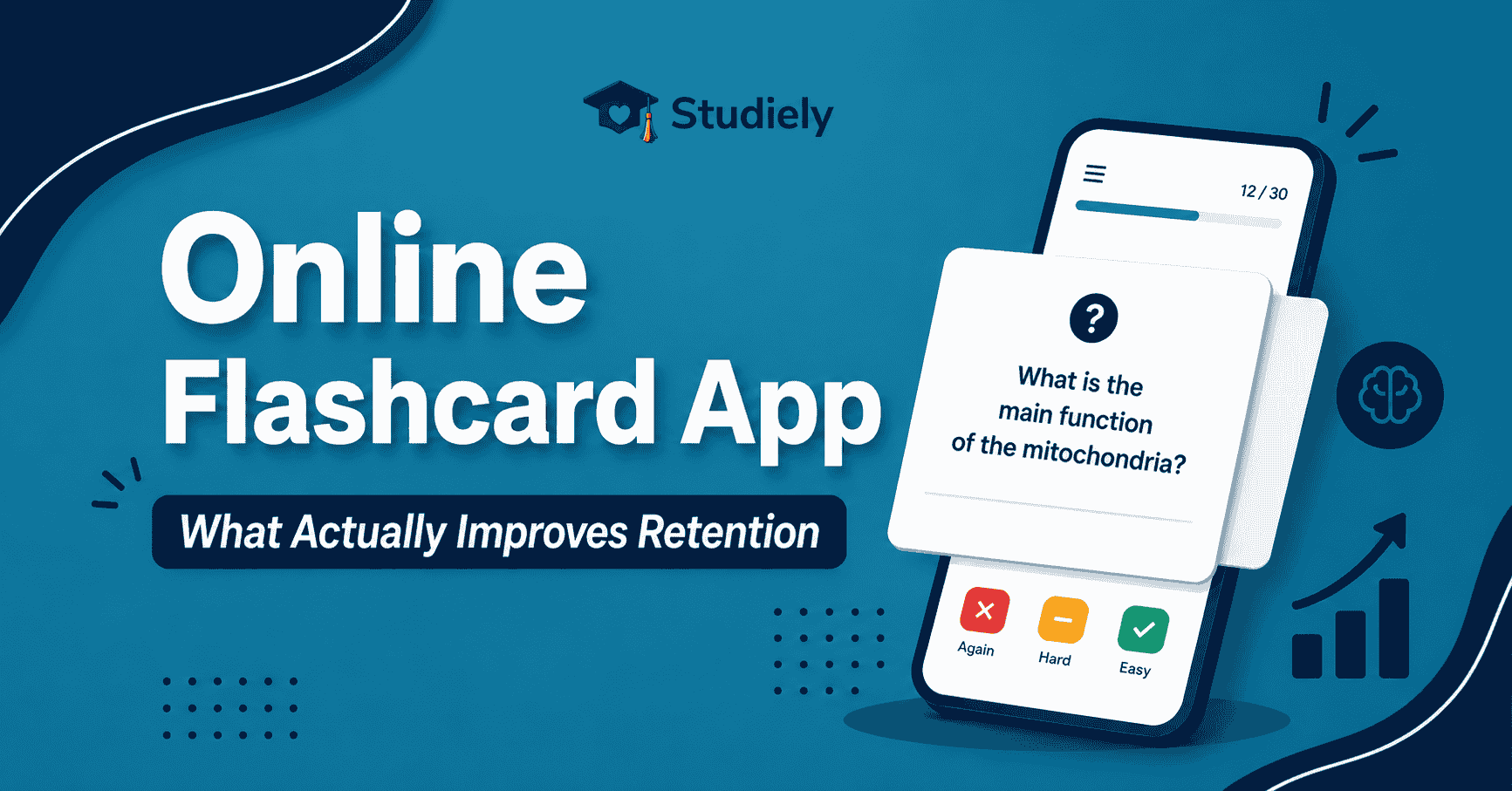
EdTech
Flashcards are one of the oldest study tools in existence and one of the most thoroughly validated by cognitive science research. The act of retrieving information from memory, as opposed to passively re-reading it, produces significantly stronger and more durable memory traces. This phenomenon, known as the testing effect or retrieval practice effect, is among the most replicated findings in educational psychology.
Yet most digital flashcard apps implement only the surface structure of flashcard study — the question-answer format — without engineering the deeper mechanics that make retrieval practice genuinely effective. Studiely is built differently. As a digital flashcard app grounded in cognitive science, it delivers not just the format but the full evidence-based system that transforms flashcard study from a rote exercise into a high-efficiency learning protocol.
The Science Behind Effective Flashcard Study
To understand what makes Studiely different from a typical study cards app, it helps to understand the cognitive mechanisms at work in effective retrieval practice:
Retrieval practice works because the act of recalling information strengthens the neural pathways associated with that knowledge. Every time you successfully retrieve a piece of information, the memory trace for that item becomes more robust and accessible in future. Conversely, attempting to retrieve information and failing — followed by immediate correct feedback — can be even more effective than successful retrieval, because the effort and the correction together create a particularly strong encoding signal.
Spaced repetition builds on this foundation by timing review sessions to occur at the point when memory strength has decayed to a specific threshold. Rather than reviewing all material with equal frequency, spaced repetition algorithms concentrate review time on the items most at risk of being forgotten — dramatically increasing the efficiency of study time.
Studiely's revision cards online system implements both of these mechanisms, calibrated at the individual card level based on each learner's actual performance history.
What Makes Studiely the Right Digital Flashcard App
There are many flashcard tools available. What distinguishes Studiely is the depth of the implementation behind the familiar interface:
Algorithmic spaced repetition: Studiely uses a modified SM-2 spaced repetition algorithm that schedules each card individually based on the learner's response history, confidence rating, and response latency. Cards that are consistently well-recalled are shown less frequently; cards that generate errors or hesitation are prioritized for review.
Active recall enforcement: Studiely's interface is designed to maximize the cognitive effort of retrieval. Learners are required to form an answer before revealing the correct response — a design constraint that ensures the retrieval attempt occurs, rather than allowing learners to passively scan the answer.
Confidence-based response grading: After each card, learners rate their confidence in their response. This metacognitive step serves two purposes: it produces a more nuanced data signal for the scheduling algorithm, and it helps learners develop more accurate self-assessment — a key predictor of effective independent study.
Multimedia card support: Studiely supports text, images, audio, mathematical notation, and code snippets within cards, making it usable across academic disciplines from languages to sciences to programming.
Deck organization and tagging: Cards can be organized by subject, topic, module, or custom tag — enabling learners to study at the granularity that matches their curriculum structure.
Building and Sharing Study Cards
A study cards app is only as useful as the quality of the cards that populate it. Studiely provides tools that make card creation efficient without sacrificing quality:
The card editor supports rich text formatting, mathematical notation via LaTeX, image embedding, and audio recording — allowing learners to create genuinely informative cards rather than being constrained to plain text. Cloze deletion (fill-in-the-blank) functionality allows learners to turn continuous text into effective retrieval practice prompts with minimal editing effort.
Studiely's import functionality accepts CSV, Anki-format decks, and plain text, allowing learners to bring existing card libraries into the system. AI-assisted card generation can transform notes, documents, and highlighted text into structured flashcard sets — reducing the time cost of deck creation and making the tool accessible to learners who find manual card authoring burdensome.
Deck sharing enables learners to distribute high-quality card sets within study groups, classes, or the broader Studiely community — creating a collaborative knowledge commons that benefits all users.
Revision Cards Online for Every Subject Area
One of the design challenges in building a genuinely versatile revision tool is ensuring that the card format works as effectively for subjects with complex, relational knowledge structures as it does for simpler vocabulary or factual recall tasks.
For language learning, Studiely supports bidirectional card study, audio pronunciation clips, and sentence-level context cards — moving beyond isolated vocabulary to support genuine communicative competence development.
For sciences, mathematical notation support and diagram embedding allow cards to represent equations, chemical structures, biological diagrams, and physical processes in their correct visual form — rather than forcing learners to describe them in words.
For humanities and social sciences, extended answer cards with evaluative criteria allow learners to practice constructing and assessing analytical responses — bridging the gap between factual recall and the higher-order thinking that examinations typically demand.
For professional certifications and vocational qualifications, Studiely's tagging system enables precise deck organization aligned with certification frameworks, allowing candidates to track mastery across specific competency domains.
Cross-Platform Access and Sync
Study does not happen in a single location or on a single device. Studiely's cross-platform architecture ensures that learners can engage with their revision cards online from any device, with full synchronization of progress, scheduling data, and settings.
The mobile application is designed for productive micro-study sessions — short, focused bursts of retrieval practice that can be completed between classes, during commutes, or in the gaps of a busy day. Desktop access supports more extended study sessions with additional organizational tools and detailed analytics views.
Offline functionality ensures that learners can study without a network connection, with data synchronizing automatically when connectivity is restored.
Analytics That Drive Better Study Decisions
One of the most common study inefficiencies is misallocated time — spending effort on well-known material while neglecting the items that actually need attention. Studiely's analytics layer addresses this directly.
Learners can view their retention rate by deck, topic, and individual card — identifying exactly where knowledge gaps exist. Study streak tracking and session analytics provide motivational structure and help learners develop consistent study habits. Predicted exam readiness scores give learners data-informed confidence assessments rather than subjective estimates.
Studiely's online flashcard app is designed for learners who want to study not just harder, but smarter. If you are ready to replace passive review with active, evidence-based retrieval practice, Studiely is the tool built for exactly that purpose.